
AI Features You Can Add to a Sports App MVP
- Mar 19
- 10 min read
Updated: Mar 20
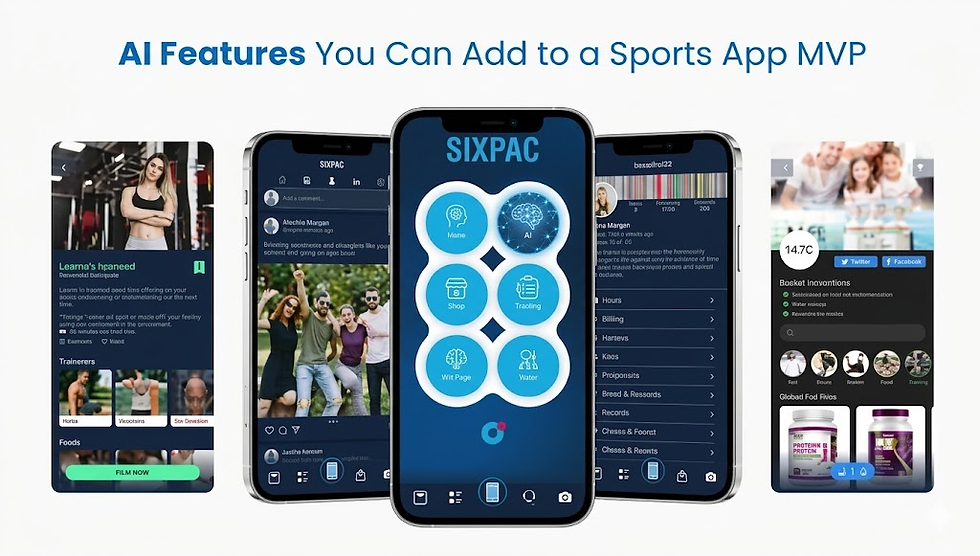
If you are a sports team, league, club, or media platform planning a new digital product, the biggest mistake is trying to build everything at once.
A smarter path is to start with an AI sports MVP.
An MVP does not mean a weak product. It means building the smallest version of a sports app that solves a real problem, gives fans a reason to return, and creates enough traction to validate future investment. When AI is added in the right way, it can make the MVP feel more dynamic, personalized, and habit-forming without making the product heavy or overly complex.
At SportsFirst, we work with sports startups, teams, and clubs that want practical innovation, not AI for show. The goal is not to add random AI labels to a product. The goal is to identify where intelligence can improve fan experience, engagement loops, and retention from day one.
This is where many products go wrong.
They add too many features, overcomplicate onboarding, or invest in advanced AI modules before proving that fans care enough to come back after the first session. A strong AI sports MVP should focus on engagement moments that are easy to understand, quick to use, and connected to the excitement of live sports.
In this guide, we will break down which AI features actually work in a sports MVP, which ones usually fail in early versions, what a clean feature stack looks like, how a sample match-day flow should work, and how teams can measure real retention uplift after launch.
Why an AI sports MVP is the right starting point
Sports products are often built with too much ambition too early. Founders and digital teams see the full vision: OTT fan engagement, community, rewards wallet, live polls, live quizzes, predictions, player content, stats intelligence, gamification, and sponsorship integrations. All of that can be valuable later. But in the MVP stage, the product needs to answer a simpler question:
Why should a fan come back next week?
That is the real test.
A good AI sports MVP helps teams validate this at lower cost, with faster release cycles and clearer data. Instead of building a huge platform, you launch a focused experience around one or two strong engagement loops. AI should support those loops by making content more relevant, interactions more timely, and fan experiences feel personalized.
For teams and clubs targeting US audiences, this matters even more. Fan attention is highly competitive. Your app is not only competing with another team's app.
It is competing with social media, fantasy platforms, streaming services, betting products, short-form content, and every second-screen experience happening during a match.
That is why sports app development today must go beyond static schedules and score updates. Fans expect interactivity. They want reasons to tap, vote, react, predict, compete, and earn something back.
What works for fan engagement in sports apps
There are certain features that consistently perform better in early-stage sports products because they are easy to understand and naturally tied to live moments.
A. Live polls
Live polls work because they are fast, low-friction, and event-driven. Fans do not need training to use them. A simple question like “Who will score next?” or “Was that the right substitution?” can drive real-time interaction during a match.
Why they work:
Fans understand them instantly
They fit second-screen behavior
They create repeated taps during live play
They can be connected to sponsor experiences or rewards
B. Live quizzes
Live quizzes create deeper interaction than polls because they add challenge and reward. They are especially useful before matches, during halftime, and in dead-ball moments.
Why they work:
They add fun without requiring heavy commitment
They improve session length
They create competition between fans
They are ideal for match-day campaigns and sponsor activations
C. Predictions
Prediction features are one of the strongest engagement tools for an AI sports MVP.
Fans like to test their sports knowledge. Predicting outcomes, player performance, or match events creates anticipation before and during games.
Why they work:
They are repeatable every match
They align with fan identity and opinion
They generate valuable behavior data
They support loyalty and points systems
D. Rewards wallet
A rewards wallet gives fans a visible reason to keep interacting. Even simple points, badges, unlocks, or redeemable rewards can improve repeat usage. When fans can earn rewards from quizzes, predictions, or attendance behavior, engagement feels more meaningful.
Why it works:
It creates a tangible return for participation
It supports long-term retention
It helps tie fan engagement to offers, sponsors, or merchandise
E. Personalized AI content nudges
AI can improve timing and personalization. Instead of giving every user the same feed, the app can prioritize the polls, quizzes, highlights, or predictions most relevant to that fan based on favorite team, previous interactions, player interest, or match-day behavior.
Why it works:
It reduces content overload
It improves click-through and interaction rates
It makes the app feel more relevant from the first few sessions
This is where SportsAI becomes practical in a product. Not in a flashy way, but in a way that helps the app feel smarter and more useful.
What usually does not work in an early MVP
A lot of teams make the mistake of launching with features that sound innovative but do not create repeated engagement.
A. Overbuilt personalization engines
Too much AI logic too early usually slows down the build and makes the product harder to test. In the MVP stage, you do not need a huge recommendation engine. You need simple, measurable personalization that improves interaction.
B. Too many features in one release
Trying to launch video, chat, community, fantasy, ticketing, merchandise, loyalty, OTT fan engagement, and advanced AI all at once is a common failure pattern. Fans do not come back because a product has more tabs. They come back because one or two flows are genuinely useful or fun.
C. AI chatbots with no clear job
An AI assistant sounds modern, but if it does not solve a real problem, it becomes a
novelty. In an MVP, a chatbot only works if it helps fans get answers quickly, discover relevant content, or navigate events better.
D. Passive content-only apps
Many teams still launch apps that are basically mobile websites with news, fixtures, and standings. That is not enough anymore. Content matters, but without interaction loops like live polls, live quizzes, or predictions, retention usually stays weak.
E. Reward systems with no value
A rewards wallet only works if fans understand how to earn and use rewards. If points have no visible purpose, the wallet becomes decorative instead of habit-forming.
Best AI features to add to a sports app MVP
Here are the most practical AI-backed features to include in an AI sports MVP.
Smart prediction engine
AI can power personalized prediction prompts based on fan history, match context, and team preferences. This does not mean fully automating fan decisions. It means surfacing smarter prediction opportunities.
Example:
A fan who often engages with player stats gets player-performance prediction cards
A fan who mostly interacts pre-match gets line-up and score prediction prompts
A fan who returns late in matches gets high-drama event prompts
Dynamic poll and quiz generation
AI can help generate or recommend timely poll and quiz content based on match events, player milestones, rivalries, or trending storylines. This reduces manual effort for content teams.
Example:
Instant poll after a controversial referee decision
Halftime quiz generated from first-half moments
Prediction challenge triggered after a substitution
Personalized engagement feed
Instead of one standard home screen, AI can prioritize the most relevant cards:
favorite club content
live interactions for ongoing matches
prediction cards based on recent behavior
earned rewards updates
upcoming OTT fan engagement experiences
This is one of the best uses of intelligence in sports app development services because it improves the product without increasing user complexity.
Smart notification timing
AI can help decide when to send engagement nudges. Timing matters. A push at kickoff, halftime, or just after a key event will perform far better than a generic notification at a random time.
Examples:
“Your prediction window closes in 3 minutes.”
“New live quiz unlocked at halftime.”
“Claim points in your rewards wallet”
Lightweight fan segmentation
An MVP does not need enterprise-grade fan data infrastructure from day one. But simple AI-based segmentation can still be useful:
casual fan
highly active match-day fan
prediction-driven user
reward-motivated user
content-first user
This helps product teams understand who is returning and why.
AI highlights or summary recommendations
If your roadmap includes video or OTT fan engagement, AI can help surface relevant clips or summaries based on user interest. Even a basic “top moments for you” section can improve repeat visits.
A simple feature stack for launch
Here is a practical MVP stack that balances speed, fan value, and retention potential.
Core MVP layer
User onboarding
Favorite team/player selection
Match center
Push notifications
Basic analytics
Engagement layer
Live polls
Live quizzes
Predictions
Leaderboard
Social share moments
Retention layer
Rewards wallet
Streaks or recurring points
Personalized home feed
Smart reminders
AI layer
Content prioritization
Match-day prompt timing
Poll/quiz suggestions
Lightweight fan segmentation
Optional expansion layer
Video modules
OTT fan engagement tools
sponsor activations
community/chat
fantasy tie-ins
commerce or ticketing
For most teams and clubs, this is a much stronger launch approach than trying to build a giant all-in-one product. This type of AI sports MVP is easier to validate, easier to improve, and more likely to create measurable traction.
Sample match-day flow for fan engagement
Below is a simple match-day experience that works well for a team or club app.
Pre-match
The fan opens the app a few hours before the game. The home screen shows:
line-up prediction card
match winner prediction
one short pre-match quiz
reminder of current points in the rewards wallet
This creates anticipation before kickoff.
Kickoff to first half
As the match begins, the app shifts into live mode:
quick live polls after major events
score or next-scorer prediction prompts
a leaderboard showing top participants
The fan is not just reading updates. They are participating.
Halftime
This is a strong engagement moment:
halftime live quiz
AI-curated “key moment so far” card
points summary added to the rewards wallet
prompt to continue streak for second-half participation
Second half
The app re-engages the fan with:
outcome predictions
event-based polls
possible reward booster challenge
Post-match
After the game:
result summary
earned points confirmation
leaderboard placement
suggested next action, such as a post-match quiz, highlight recap, or early poll for the next fixture
This flow works because it is tied to natural fan behavior. It does not ask users to learn a new product category. It improves the experience they already want during match day.
How to measure retention uplift properly
A sports app MVP should not be judged only by installs. What matters more is whether fans come back and participate again.
Here are the most useful metrics to track.
Activation rate
How many new users complete the first meaningful action?
Examples:
make a prediction
answer a poll
Join a quiz
Select a favorite team
If activation is low, the onboarding or initial value proposition is weak.
Match-day engagement rate
How many active users engage during a live event? Track:
poll participation rate
quiz completion rate
prediction submissions per match
Rewards wallet interactions
Repeat session rate
How many users return for the next match or next engagement window?
This is one of the best indicators of whether your AI sports MVP is creating a habit.
Day 7 and Day 30 retention
Sports products often have uneven usage patterns because engagement follows fixtures. So retention should also be studied in relation to event cycles, not only traditional app intervals.
Questions to ask:
Do users return for the next match?
Do they return after the first reward?
Do they engage more after personalized prompts?
Feature-level retention impact
Measure which features correlate with return behavior.
For example:
users who participate in 3+ live polls may return 2x more often
Users who use the rewards wallet may have stronger week-over-week retention
Users who receive personalized prompts may show higher engagement during live windows
Retention uplift formula
A simple way to assess improvement:
Retention uplift = ((new retention rate - old retention rate) / old retention rate) x 100
Example:
old 30-day retention = 12%
new 30-day retention = 18%
uplift = 50%
This is the type of signal that proves the MVP is working.
Common mistakes teams make
Building for internal assumptions, not fan behavior
Internal stakeholders often want many features, but fans usually care about speed, simplicity, and relevance.
Treating AI as a headline, not a product tool
A sports app does not become better just because “AI” is in the pitch deck. It becomes better when intelligence improves personalization, timing, content relevance, or retention loops.
Ignoring the second-screen reality
Modern sports fans use multiple screens. Good sports app development must support that behavior instead of competing with it.
Launching without a measurement plan
If you do not define activation, match-day engagement, and retention targets before launch, it becomes harder to know what to improve.
Underestimating content operations
Even in an MVP, content matters. Polls, quizzes, predictions, and prompts need a clear system. AI can help, but there still needs to be product logic behind it.
How SportsFirst approaches AI sports MVP development
At SportsFirst, we believe the best sports products win because they combine domain understanding with practical execution.
A good sports technology partner should not just code features. They should help you decide:
which fan engagement loops are worth building first
where AI adds real value
how to shape an MVP around retention, not vanity metrics
how to structure the roadmap so the product can grow without becoming bloated
That is where sports app development services become more strategic. The goal is not simply to ship an app. The goal is to launch a product that creates signals: engagement, repeat use, sponsor value, data insights, and a stronger digital relationship with fans.
Whether you are a team, club, league, OTT platform, or sports startup, the right AI sports MVP can help you move faster, learn faster, and build a more investable sports product.
FAQs
1. What is an AI sports MVP?
An AI sports MVP is the minimum version of a sports product that includes essential features plus focused AI functionality to improve fan engagement, personalization, or retention without overbuilding the platform.
2. Which AI features are best for a sports app MVP?
The most useful early features usually include personalized engagement feeds, smart prediction prompts, AI-supported poll and quiz generation, lightweight fan segmentation, and better notification timing.
3. Are live polls and live quizzes good for fan retention?
Yes. Live polls and live quizzes work well because they are easy to join, tied to live match moments, and create repeated engagement opportunities during the event.
4. How does a rewards wallet help in a sports app?
A rewards wallet gives fans a visible benefit for participating in predictions, polls, quizzes, and repeat visits. It helps connect engagement to value and supports better long-term retention.
5. What should not be included in an MVP?
Avoid adding too many modules at once, such as full social communities, heavy fantasy systems, overly complex AI engines, or passive content sections with no engagement loop. The MVP should stay focused.
6. How do teams measure if their sports MVP is working?
Track activation rate, match-day engagement, repeat sessions, Day 7 and Day 30 retention, and feature-level usage. The goal is to see whether fans are returning and interacting more over time.
7. Can OTT fan engagement be part of a sports MVP?
Yes, but usually in a lightweight form. For example, AI-curated content prompts, post-match highlights, or simple interactive layers tied to streaming can fit into an MVP better than building a full OTT platform from day one.
8. Why choose SportsFirst for sports app development?
SportsFirst combines sports domain experience, product strategy, and AI thinking to help teams and clubs build focused digital products that are practical, scalable, and aligned with fan behavior.

Comments